

Celex Oncology plans up to GBP 30m raise to fund late-stage trial
Celex Oncology plans to raise capital in 3Q26 to support its lead drug candidate through to potential US Food and Drug Administration (FDA) approval, said co-founder and CEO Carsten Faltum.
The UK-based biotechnology company will seek GBP 20m-GBP 30m (USD 26.4m-USD 39.7m) primarily from institutional investors in the US, as well as Europe, Faltum said. Proceeds will support CL-S03 through a Phase 2/3 clinical trial set to begin in early 2027, he added.
Faltum said Celex has raised GBP 6m in capital and is about to close a USD 4m round. Its capitalisation table consists primarily of family offices.
Celex is focused on treatments that slow or halt progression of cancer and metastasis by targeting sodium overload in tumour cells, a crucial cell component and key regulator of tumour cell behavior, according to Faltum. The company is initially targeting pancreatic cancer, with CL-S03 intended to complement standard treatments like chemotherapy and immunotherapy and potentially improve their effectiveness, he said.
Moreover, CL-S03 targets only malfunctioning cells, resulting in fewer side effects, the CEO added.
The Phase 2/3 trial is expected to take three years, after which the company will file for a new drug application (NDA), if successful, according to Faltum. FDA approval could come as soon as 2030-31, he said.
Celex may start attracting serious partner or buyer interest halfway through the trial, or around mid-2028, the CEO added.
Pancreatic cancer treatment is currently available at only a limited number of centres, which Celex could reach independently, Faltum said. However, to fully capture the “significant market opportunity” — given rising cases and high mortality — the ideal path would be a partnership or sale to a larger strategic player, he added.
The company would consider licensing agreements for certain indications or geographies, or a full acquisition, Faltum said. He noted larger pharmaceutical companies with KRAS inhibitor programmes, such as Merck, Roche, and Novartis, as logical strategic partners or acquirers. KRAS inhibitor programmes target cancers driven by mutations in the KRAS gene, which controls signals that tell cells when to grow and divide.
Every year in the US, there are around 66,000 new cases of pancreatic cancer, with approximately 87% of people diagnosed dying within five years, according to the National Cancer Institute. Pancreatic cancer may become the second leading cause of cancer‑related deaths (behind lung cancer) by 2030 because of demographic shifts and limited progress in early detection and treatment, reports the Pancreatic Cancer Action Network.
Once CL-S03 is approved in the US, Celex will seek approval in other regions such as Europe and China, Faltum said. Potential indications to follow include triple-negative breast cancer, according to Faltum, who said the company has identified more than 25 tumour types.
“We have used ranolazine, which targets our channel, but is marketed for Angina pectoris, as a model drug,” Faltum said. In 165 patients that had angina and developed cancer, Ranolazine treatment resulted in a significant 60% reduction in cancer-related mortality over 10 years in patients with breast, colon, and prostate cancer, he noted.
According to Faltum, “no one is addressing sodium in oncology”. He pointed to Dutch biotech firm Merus, which is developing antibody therapies for cancer, as an adjacent player that is in the process of being acquired by Genmab in an all‑cash deal valued at approximately USD 8bn.
Celex was spun-out of Imperial College London in 2017. Faltum, 56, a former medical device and product executive at companies including Coloplast, Biolin Scientific, and Medela, joined as founding COO and was promoted to CEO in 2024.
The company has 10 corporate employees and 10 patent families. It works with law firm Child & Child and accounting firm Harris & Trotter.

The True Cost of Clinical Trials
Bringing a new drug to market can cost billions. Here’s the tally for each phase of a clinical trial—and how those costs dictate what you pay at the pharmacy.
Clinical trials are the scientific engine behind nearly every new innovative therapy for chronic conditions including autoimmune, genetic, and neurological disorders. Rigorous studies are especially important for developing treatments for rare conditions that have historically received less research attention. Without them, life-saving discoveries made in laboratories would never reach those who are diagnosed with these diseases.
Even so, conducting a clinical trial is an enormous undertaking, often requiring more than a decade to organize and running up serious sums to launch and see through, according to recent research that details how drug development can take 10 to 15 years from discovery to approval for clinical use, costing anywhere between $1 billion to $2 billion.
Read more at: Health Central

Single pivotal trial now the default for full drug approval?
What does our CEO Carsten Faltum think about the FDA’s new stance that a single pivotal trial is now the default for full drug approval?
Click below to see what Carsten discussed with BioSpace - what this means for drug development, why trial design quality matters more than ever and how Celex Oncology Innovations Ltd’s pancreatic cancer programme was built around this approach from the outset.
Read his perspective in full in BIOSPACE

Life Science Daily News
We’re pleased to see our Director and General Counsel, Larry Cohen, published today in Life Science Daily News.
In this article, Larry explores a critical issue facing biotech companies as innovation accelerates: how to communicate emerging science responsibly without creating unintended regulatory or commercial risk. The piece examines the interplay between real-world evidence, intellectual property strategy and off-label use, and why disciplined communication has become a strategic capability rather than a compliance exercise.
At Celex Oncology Innovations Ltd Oncology, we believe that strong governance and responsible innovation go hand in hand. Clear thinking at the intersection of law, regulation and science is essential to translating promising biology into durable clinical and commercial outcomes.
Congratulations to Larry on a thoughtful contribution to an important industry conversation.
The Full story can be read on: Life Science Daily
Pancreatic Cancer Awareness Month
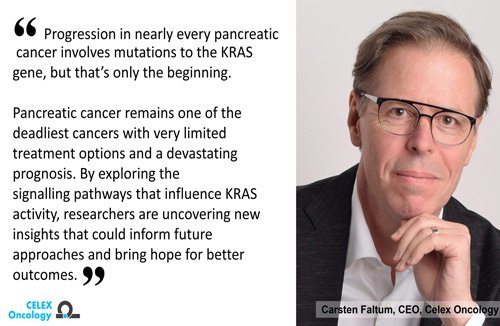
This November, during Pancreatic Cancer Awareness Month, we’re reflecting on where new hope is emerging in one of the hardest cancers to treat.
About 90% of pancreatic cancers carry a mutation called KRAS - a change that helps tumours grow and spread without any restrictions.
At Celex Oncology Innovations Ltd, our research focuses on voltage-gated sodium channels (VGSCs) - molecules that sit upstream of KRAS and influence how aggressive cancer cells become.
Let’s take a look at what our CEO Carsten Faltum says about why new treatment methods are needed.
By understanding and targeting these early drivers of tumour behaviour, we aim to help pave the way for future approaches that may one day slow or better manage the spread of pancreatic cancer.
Because when you decode how cancer is progressing, you can start to control it.

EU Pharma Reform
Celex Oncology Innovations Ltd was recently highlighted in Pink Sheet’s article, “EU Pharma Reform: Lawyers Unpack Diverging Visions for Innovation,” where we shared our insights on harmonising HTA, incentive models and launch strategies across Europe.
This spotlight aligns perfectly with our core mission at Celex Oncology:
⚕️Bioelectric‑driven oncology: We’re pioneering inhibitors of voltage-gated sodium channels (VGSCs), such as Nav 1.5, which uniquely target tumour cell aggression, a mechanism backed by strong preclinical and real-world data
⚕️Transforming metastatic care: Our proprietary pipeline targeting tumour metastasis is advancing through preclinical stages toward clinical development.
⚕️European expansion and equity: As EU regulations evolve, our work underscores why coherent HTA frameworks and pan-EU launch incentives are vital to ensure innovative, life-extending therapies like ours reach every patient in Europe without delay
With the EU refining its pharma package and global market access trends intensifying, Celex Oncology stands ready to deliver on its promise: turning invasive tumours benign, extending life and preserving quality through groundbreaking science and strategic launch excellence.
➡️Read the full Pink Sheet feature to discover how we’re shaping the future of oncology innovation and access in Europe. Connect with us to explore opportunities for collaboration, investment or partnership.
Full Article here on Pink Sheet
3 Ways Biotechs Can Relieve The Burden Of Their First Clinical Trial
By Katia Schlienger, MD, Ph.D., chief medical officer, Celex Oncology Innovations, Ltd.
Small biotech companies face significant challenges when advancing new drugs from early development into clinical trials, especially in oncology. While they often partner with CROs for Phase 1/2, first-in-human, Phase 2b/3, or RWE studies, this approach is not ideal as biotechs, which must ensure patient safety first, have to establish a parallel internal framework to oversee the CRO (biotechs retain full regulatory responsibility when working with CROs).
This oversight demands substantial internal expertise and a significant expansion of their organization to address additional governance structures. Specifically, small biotechs lack the infrastructure to oversee CRO-run trials, requiring the hiring of new teams for project management, operations, quality control, regulatory compliance, safety monitoring, biomarker strategy, analytics, and clinical site management - functions larger pharmaceutical companies typically manage in-house. Furthermore, managing multiple vendors, ensuring data integrity across different systems, navigating fragmented trials, and coordinating with external oversight bodies, such as data and safety monitoring boards (DSMBs), all add considerable complexity and inefficiency.
Adaptive trial designs, which permit planned modifications in response to ongoing trial data, together with real-world evidence (RWE) approaches, promise to soften some of these burdens – for example, by improving trial flexibility, better aligning the trial protocol with patients’ actual care settings, and boosting evidentiary support for regulatory and commercial decision-making. Yet, adopting adaptive trials and integrating RWE still require robust oversight, regulatory clarity, and organizational capacity — issues small biotechs must address to benefit from these evolving methods.
Read the full story at Clinical Leader
Beyond traditional cancer treatment
Surgery, chemotherapy, radiotherapy, and immunotherapy are designed to kill cancer, but what if we could control cancer?
Cancer care has seen remarkable progress with targeted therapies, AI-enabled diagnostics and early detection tools. However, treatment approach has remained static for decades, focusing on eliminating primary tumours and killing cancer. The reality is that patients are at the mercy of metastasis, which is responsible for 90% of cancer deaths. Are we stuck in a paradigm that we are struggling to escape?
Foundational assumptions need challenging, including the idea that cancer cells must be eliminated at all costs. What if we approached cancer differently? What if cancer is something to be managed and controlled over time, like diabetes, which over 100 years ago saw a shift in the approach from cure to management?
Here, we explore gaps in oncology and cancer care, proposing a collective call for intelligent innovation and radical collaboration. Together we can work towards the fourth revolution in cancer care, prioritising control, quality of life, and long-term management.Read more at PharmaPhorum